
Introduction
When a customer fills out a form, calls your business, or makes a purchase, do you know which marketing channel influenced the decision?
A customer may discover your business through Google, return through social media, read a blog, and finally convert through a paid advertisement.
Marketing attribution helps identify how different channels contribute to conversions, allowing businesses to make better marketing and budget decisions.
What Is Marketing Attribution?
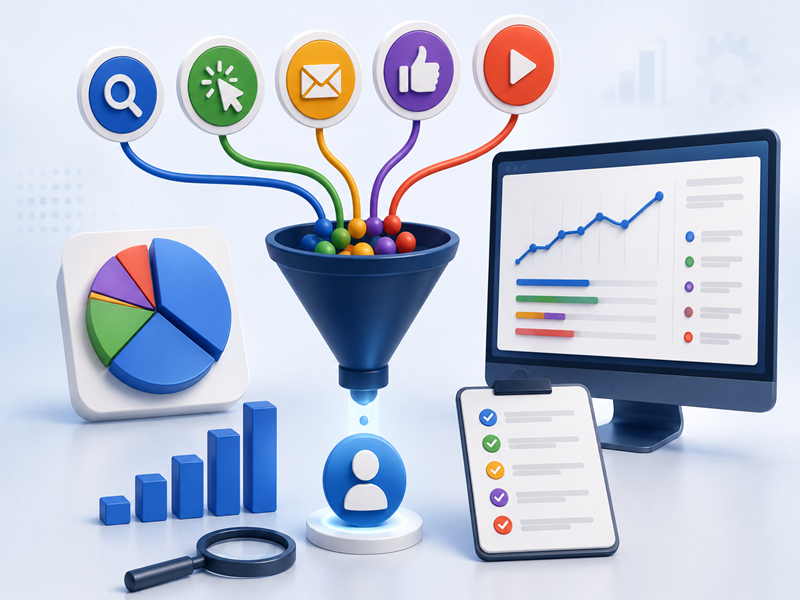
Marketing attribution is the process of identifying which marketing channels or touchpoints influence a conversion.
These may include:
- SEO
- Google Search
- Social media
- Paid advertising
- Email marketing
- Content marketing
- Referral traffic
For example, Instagram may create awareness, Google may bring the customer back, and your website may convert the visitor. Attribution helps businesses understand this complete journey.
Why Is Marketing Attribution Important?
Many businesses track leads but do not track where they came from. This can lead to poor budget decisions.
Attribution helps businesses:
- Understand customer journeys
- Identify effective channels
- Measure campaign performance
- Improve budget allocation
- Reduce wasted marketing spend
- Make data-driven decisions
Common Attribution Models
First-Touch Attribution
This model gives credit to the first interaction, such as an Instagram post that introduced the customer to your business.
Last-Touch Attribution
This model gives credit to the final interaction before conversion, such as a paid advertisement clicked before submitting a form.
Linear Attribution
This model distributes credit equally across all customer touchpoints.
Data-Driven Attribution
This model uses conversion data to determine which interactions contributed most to the conversion.
The right model depends on your business, sales cycle, and customer journey.
How to Track Lead Sources
Businesses can use the following methods to track where leads come from:
Website Analytics
Analytics tools show traffic sources, user behaviour, landing pages, and conversions.
UTM Parameters
UTM links help track traffic from social media, email campaigns, paid ads, and other promotions.
Conversion Tracking
Track actions such as:
- Form submissions
- Phone calls
- Purchases
- Bookings
- Quote requests
CRM Data
A CRM connects marketing leads with sales results. This helps identify which channels generate not only leads, but also paying customers.
Why Leads Alone Are Not Enough
The channel generating the most leads may not generate the most customers.
For example, Campaign A may generate 100 leads, while Campaign B generates only 40. However, if more customers come from Campaign B, it may deliver better results.
Businesses should also measure:
- Qualified leads
- Conversion rate
- Cost per lead
- Customer acquisition cost
- Sales generated
- Return on investment
How Attribution Improves Marketing Budgets
Attribution shows where your marketing budget is working.
If SEO generates qualified leads while a paid campaign produces clicks but few conversions, you can improve the landing page, refine targeting, change the ad message, or reallocate the budget.
The goal is to understand why a channel performs well or poorly.
Common Attribution Mistakes
- Relying only on last-click data
- Ignoring phone calls and offline conversions
- Using incorrect tracking
- Focusing only on website traffic
- Using the same attribution model for every campaign
How Extensile Media Can Help
Extensile Media uses strategy, analytics, SEO, PPC, social media, content marketing, and conversion tracking to help businesses understand and improve their digital marketing performance.
By analyzing customer journeys and campaign results, businesses can generate better leads and make smarter marketing decisions.
Conclusion
Marketing attribution helps businesses understand which channels influence leads and customers.
Instead of asking only, “How many leads did we get?” businesses can ask, “Which marketing activities helped generate those leads?”
For businesses seeking a data-driven marketing strategy, Extensile Media, the best digital marketing agency in Hadapsar, combines strategy, creativity, analytics, and optimization to support measurable growth.
Marketing Attribution Explained: How to Know Which Channel Drives Your Leads
Introduction
When a customer fills out a form, calls your business, or makes a purchase, do you know which marketing channel influenced the decision?
A customer may discover your business through Google, return through social media, read a blog, and finally convert through a paid advertisement.
Marketing attribution helps identify how different channels contribute to conversions, allowing businesses to make better marketing and budget decisions.
What Is Marketing Attribution?
Marketing attribution is the process of identifying which marketing channels or touchpoints influence a conversion.
These may include:
- SEO
- Google Search
- Social media
- Paid advertising
- Email marketing
- Content marketing
- Referral traffic
For example, Instagram may create awareness, Google may bring the customer back, and your website may convert the visitor. Attribution helps businesses understand this complete journey.
Why Is Marketing Attribution Important?
Many businesses track leads but do not track where they came from. This can lead to poor budget decisions.
Attribution helps businesses:
- Understand customer journeys
- Identify effective channels
- Measure campaign performance
- Improve budget allocation
- Reduce wasted marketing spend
- Make data-driven decisions
Common Attribution Models
First-Touch Attribution
This model gives credit to the first interaction, such as an Instagram post that introduced the customer to your business.
Last-Touch Attribution
This model gives credit to the final interaction before conversion, such as a paid advertisement clicked before submitting a form.
Linear Attribution
This model distributes credit equally across all customer touchpoints.
Data-Driven Attribution
This model uses conversion data to determine which interactions contributed most to the conversion.
The right model depends on your business, sales cycle, and customer journey.
How to Track Lead Sources
Businesses can use the following methods to track where leads come from:
Website Analytics
Analytics tools show traffic sources, user behaviour, landing pages, and conversions.
UTM Parameters
UTM links help track traffic from social media, email campaigns, paid ads, and other promotions.
Conversion Tracking
Track actions such as:
- Form submissions
- Phone calls
- Purchases
- Bookings
- Quote requests
CRM Data
A CRM connects marketing leads with sales results. This helps identify which channels generate not only leads, but also paying customers.
Why Leads Alone Are Not Enough
The channel generating the most leads may not generate the most customers.
For example, Campaign A may generate 100 leads, while Campaign B generates only 40. However, if more customers come from Campaign B, it may deliver better results.
Businesses should also measure:
- Qualified leads
- Conversion rate
- Cost per lead
- Customer acquisition cost
- Sales generated
- Return on investment
How Attribution Improves Marketing Budgets
Attribution shows where your marketing budget is working.
If SEO generates qualified leads while a paid campaign produces clicks but few conversions, you can improve the landing page, refine targeting, change the ad message, or reallocate the budget.
The goal is to understand why a channel performs well or poorly.
Common Attribution Mistakes
- Relying only on last-click data
- Ignoring phone calls and offline conversions
- Using incorrect tracking
- Focusing only on website traffic
- Using the same attribution model for every campaign
How Extensile Media Can Help
Extensile Media uses strategy, analytics, SEO, PPC, social media, content marketing, and conversion tracking to help businesses understand and improve their digital marketing performance.
By analyzing customer journeys and campaign results, businesses can generate better leads and make smarter marketing decisions.
Conclusion
Marketing attribution helps businesses understand which channels influence leads and customers.
Instead of asking only, “How many leads did we get?” businesses can ask, “Which marketing activities helped generate those leads?”
For businesses seeking a data-driven marketing strategy, Extensile Media, the best digital marketing agency in Hadapsar, combines strategy, creativity, analytics, and optimization to support measurable growth.