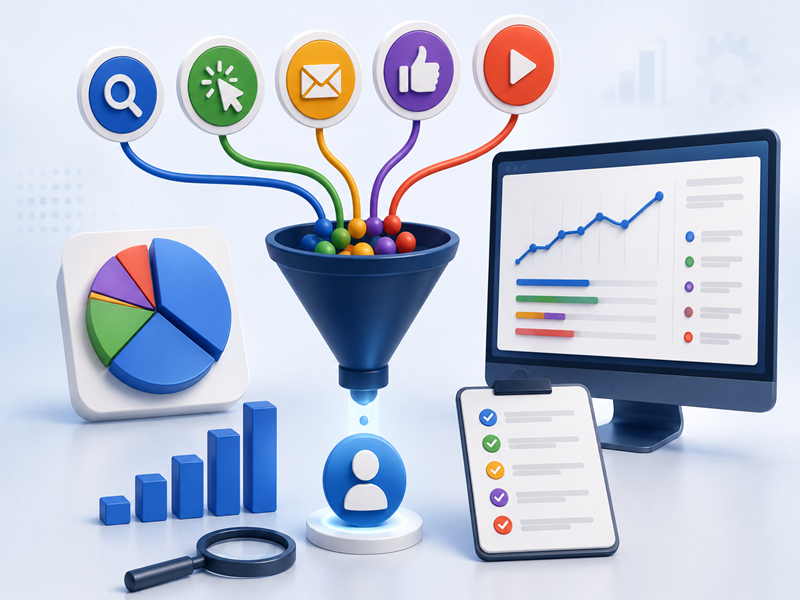
Introduction When a customer fills out a form, calls your business, or makes a purchase, do you know which marketing channel influenced the decision? A customer may discover your business through Google, return through social media, read a blog, and finally convert through a paid advertisement. Marketing attribution helps identify how different channels contribute to conversions, allowing businesses to make better marketing and budget decisions. What Is Marketing Attribution? Marketing attribution is the process of identifying which marketing channels or touchpoints influence a conversion. These may include: For example, Instagram may create awareness, Google may bring the customer back, and your website may convert the visitor. Attribution helps businesses understand this complete journey. Why Is Marketing Attribution Important? Many businesses track leads but do not track where they came from. This can lead to poor budget decisions. Attribution helps businesses: Common Attribution Models First-Touch Attribution This model gives credit to the first interaction, such as an Instagram post that introduced the customer to your business. Last-Touch Attribution This model gives credit to the final interaction before conversion, such as a paid advertisement clicked before submitting a form. Linear Attribution This model distributes credit equally across all customer touchpoints. Data-Driven Attribution This model uses conversion data to determine which interactions contributed most to the conversion. The right model depends on your business, sales cycle, and customer journey. How to Track Lead Sources Businesses can use the following methods to track where leads come from: Website Analytics Analytics tools show traffic sources, user behaviour, landing pages, and conversions. UTM Parameters UTM links help track traffic from social media, email campaigns, paid ads, and other promotions. Conversion Tracking Track actions such as: CRM Data A CRM connects marketing leads with sales results. This helps identify which channels generate not only leads, but also paying customers. Why Leads Alone Are Not Enough The channel generating the most leads may not generate the most customers. For example, Campaign A may generate 100 leads, while Campaign B generates only 40. However, if more customers come from Campaign B, it may deliver better results. Businesses should also measure: How Attribution Improves Marketing Budgets Attribution shows where your marketing budget is working. If SEO generates qualified leads while a paid campaign produces clicks but few conversions, you can improve the landing page, refine targeting, change the ad message, or reallocate the budget. The goal is to understand why a channel performs well or poorly. Common Attribution Mistakes How Extensile Media Can Help Extensile Media uses strategy, analytics, SEO, PPC, social media, content marketing, and conversion tracking to help businesses understand and improve their digital marketing performance. By analyzing customer journeys and campaign results, businesses can generate better leads and make smarter marketing decisions. Conclusion Marketing attribution helps businesses understand which channels influence leads and customers. Instead of asking only, “How many leads did we get?” businesses can ask, “Which marketing activities helped generate those leads?” For businesses seeking a data-driven marketing strategy, Extensile Media, the best digital marketing agency in Hadapsar, combines strategy, creativity, analytics, and optimization to support measurable growth.
PPC Mistakes That Waste Your Advertising Budget and How to Avoid Them
Introduction Pay-per-click (PPC) advertising can quickly bring targeted traffic, leads, and sales. However, poor targeting, irrelevant keywords, weak ad copy, and limited optimization can waste your budget. At Extensile Media, the best digital marketing agency in Hadapsar, we focus on clear goals, audience research, data, and continuous improvement. Here are common PPC mistakes and how to avoid them. 1. Not Defining a Clear Goal Starting a campaign without a clear objective makes it difficult to choose the right settings and measure success. Your goal may be to generate leads, increase sales, receive calls, or drive website traffic. How to avoid it Choose one primary goal and align your ads, landing page, targeting, and tracking with it. 2. Targeting the Wrong Audience If your ads reach people who do not need your product or service, your budget will be wasted. How to avoid it Define your ideal customer and target the right location, interests, demographics, and search intent. Local businesses should focus on their actual service areas. 3. Choosing Irrelevant Keywords High search volume does not always mean high buying intent. Some users are only looking for information. How to avoid it Choose keywords based on search intent and focus on terms related to your products or services. 4. Ignoring Negative Keywords Without negative keywords, your ads may appear for irrelevant searches such as jobs, free courses, or tutorials. How to avoid it Review search terms regularly and add irrelevant queries to your negative keyword list. 5. Writing Generic Ad Copy Generic ads do not explain why customers should choose your business. How to avoid it Highlight your service, key benefits, target audience, and a clear call to action such as “Get a Free Consultation.” 6. Sending Traffic to the Homepage Sending every visitor to the homepage can make it difficult for them to find the information they need. How to avoid it Use focused landing pages that match the ad, load quickly, work well on mobile, and include a clear enquiry option. 7. Focusing Only on Clicks Clicks are useful, but they do not guarantee leads or sales. How to avoid it Track conversion rate, cost per lead, sales, qualified enquiries, and return on advertising spend. 8. Not Optimizing Campaigns PPC campaigns require regular monitoring. Keyword performance, competition, and customer behaviour can change over time. How to avoid it Review high-cost keywords, ad performance, search terms, locations, devices, and conversions regularly. 9. Not Testing Ad Variations Using only one ad makes it difficult to know which message works best. How to avoid it Test different headlines, offers, benefits, and calls to action. Use performance data to improve your ads. 10. Ignoring Mobile Users A poor mobile experience can cause visitors to leave before submitting an enquiry. How to avoid it Ensure your landing pages are mobile-friendly, fast, easy to read, and simple to navigate. 11. Using Incorrect Location Targeting Advertising outside your service area can lead to irrelevant clicks and enquiries. How to avoid it Target the cities, neighbourhoods, or regions where your customers are located, and review location performance regularly. 12. Not Tracking Conversions Without conversion tracking, you cannot know which campaigns are generating real business results. How to avoid it Track form submissions, calls, purchases, bookings, WhatsApp enquiries, and sign-ups. 13. Making Changes Too Quickly Judging a campaign too early can lead to poor decisions. How to avoid it Allow enough time to collect useful data. Make controlled changes and monitor the results. 14. Ignoring Competitors Competitors may attract customers with stronger offers, better messaging, or improved landing pages. How to avoid it Review competitor ads and offers regularly, then find ways to differentiate your business. How Extensile Media Helps At Extensile Media, PPC campaigns are planned around business goals, audience research, relevant targeting, strong ad copy, and continuous optimization. The agency also provides SEO, social media marketing, website design, branding, and content marketing to support complete digital growth. Conclusion PPC can deliver excellent results, but poor planning and management can quickly waste your budget. To improve performance, define clear goals, target the right audience, use relevant keywords, create focused landing pages, track conversions, and optimize regularly. The goal is not always to spend more, but to spend smarter. Extensile Media, the best digital marketing agency in Hadapsar, helps businesses create customized, performance-focused digital marketing strategies.
Meta Ads vs Google Ads: Which Platform Is Better for Lead Generation?
Introduction Generating quality leads is an important goal for businesses investing in digital marketing. Two popular advertising platforms that businesses often consider are Meta Ads and Google Ads. But which one is better for lead generation? The answer depends on your target audience, business type, budget, and marketing objectives. Both platforms can help businesses reach potential customers, but they work differently. What Are Meta Ads? Meta Ads are paid advertisements displayed across platforms such as Facebook and Instagram. Businesses can use images, videos, carousels, and lead forms to promote their products or services to relevant audiences. Meta Ads can help businesses: They can be especially useful for industries such as real estate, education, fashion, hospitality, beauty, and lifestyle businesses where visual content plays an important role. What Are Google Ads? Google Ads allows businesses to display advertisements when users search for relevant products or services. For example, someone searching for “digital marketing agency in Hadapsar” is already looking for a service provider. A well-planned Google Ads campaign can help a business reach that potential customer at the right time. Google Ads can help businesses: For service-based businesses, Google Ads can be particularly valuable because customers are often searching for a solution when they are ready to take action. Which Platform Is Better for Lead Generation? There is no single answer. Google Ads can be effective when customers are already searching for a product or service. This makes it useful for businesses that want to capture existing demand. Meta Ads can be effective when businesses want to introduce their brand to new audiences and create interest through engaging content. For example, someone may not be actively searching for a coaching institute. However, after seeing a relevant course advertisement on Instagram, they may become interested and submit an enquiry. The quality of leads also depends on targeting, ad messaging, offers, landing pages, and follow-up. When Should You Choose Meta Ads? Meta Ads can be a good option when your business wants to: If your product needs to be discovered before customers make a decision, Meta can help create that initial interest. When Should You Choose Google Ads? Google Ads can be a strong choice when: It can help connect your business with customers who are already looking for a solution. Can You Use Meta Ads and Google Ads Together? Yes. In many cases, using both platforms can create a stronger lead generation strategy. Meta Ads can introduce your brand to potential customers and build awareness. Later, those customers may search for your business or service on Google. This creates a customer journey such as: Awareness → Interest → Search → Enquiry → Customer Using both platforms also gives businesses more opportunities to reach customers at different stages of their decision-making process. Common Paid Advertising Mistakes Even a good advertising platform can produce poor results when campaigns are not managed properly. Common mistakes include: The goal should not simply be to generate clicks. The real goal is to generate qualified leads that can become customers. How Extensile Media Can Help Successful paid advertising requires strategy, audience research, relevant messaging, performance tracking, and continuous optimization. Extensile Media provides digital marketing services including SEO, website design, social media marketing, Meta Ads, branding, and performance-focused marketing strategies. For businesses searching for the best digital marketing agency in Hadapsar, a customized approach can help connect paid advertising with the overall digital marketing strategy. Conclusion So, Meta Ads or Google Ads? The right choice depends on your business and customers. Google Ads can help capture people who are actively searching for your products or services. Meta Ads can help create awareness, reach new audiences, and generate interest. For many businesses, combining both platforms can provide more opportunities for lead generation. The focus should always be on reaching the right audience, delivering the right message, and turning interest into meaningful business results.
Digital Marketing KPIs Every Business Should Measure
Introduction Running digital marketing campaigns without measuring performance is like driving without a destination. Whether you’re investing in SEO, Google Ads, social media marketing, or email campaigns, tracking the right Key Performance Indicators (KPIs) helps you understand what’s working and where improvements are needed. Digital marketing KPIs provide valuable insights into website performance, customer behavior, lead generation, and return on investment (ROI). By monitoring these metrics, businesses can make informed decisions and achieve better marketing results. What Are Digital Marketing KPIs? Digital Marketing KPIs are measurable values that show how effectively your marketing efforts are achieving business goals. They help businesses evaluate campaign performance, optimize strategies, and maximize their marketing budget. Essential Digital Marketing KPIs 1. Website Traffic Website traffic measures the number of visitors coming to your website. Monitoring traffic helps you understand how well your marketing campaigns attract potential customers. 2. Organic Traffic Organic traffic refers to visitors who find your website through search engines without paid advertising. An increase in organic traffic usually indicates strong SEO performance. 3. Conversion Rate The conversion rate measures the percentage of visitors who complete a desired action, such as filling out a contact form, making a purchase, or subscribing to a newsletter. 4. Cost Per Lead (CPL) CPL calculates how much it costs to generate a single lead. Lowering your CPL while maintaining lead quality improves marketing efficiency. 5. Click-Through Rate (CTR) CTR shows how many users click on your ads, emails, or search results after seeing them. A higher CTR often indicates compelling content and effective targeting. 6. Bounce Rate Bounce rate measures the percentage of visitors who leave your website without interacting with other pages. A lower bounce rate generally indicates a better user experience. 7. Return on Investment (ROI) ROI helps determine whether your marketing campaigns are generating more revenue than they cost. It is one of the most important KPIs for measuring overall success. 8. Customer Acquisition Cost (CAC) CAC measures the average cost of acquiring a new customer. Keeping this cost under control helps improve profitability. Why Tracking KPIs Matters Monitoring digital marketing KPIs helps businesses: Best Practices for Measuring KPIs To achieve better results: How Extensile Media Helps At Extensile Media, we help businesses measure and improve their digital marketing performance through SEO, Google Ads, social media marketing, website optimization, and performance reporting. Our data-driven approach ensures every campaign is optimized for measurable growth. Conclusion Tracking the right digital marketing KPIs enables businesses to understand campaign performance, improve decision-making, and achieve sustainable growth. By monitoring essential metrics like traffic, conversions, CTR, ROI, and lead generation, businesses can continuously optimize their marketing strategies and maximize results.
AI in Digital Marketing: Everything Businesses Need to Know
Introduction Artificial Intelligence (AI) has become one of the biggest innovations in digital marketing. It is changing how businesses connect with customers, analyze data, create content, and optimize marketing campaigns. Instead of relying only on manual processes, businesses can now use AI-powered tools to make faster decisions, improve efficiency, and deliver personalized experiences. Whether you run a startup, a local business, or a large enterprise, AI can help you save time, reduce costs, and achieve better marketing results. However, AI works best when combined with human creativity and strategic planning. In this blog, we’ll explore how AI is transforming digital marketing, its benefits, popular applications, and best practices for businesses. What Is AI in Digital Marketing? AI in digital marketing refers to the use of artificial intelligence, machine learning, and automation technologies to improve marketing activities. These technologies analyze large amounts of customer data, identify patterns, predict user behavior, and automate repetitive tasks. AI enables marketers to make data-driven decisions, improve customer engagement, and deliver the right message to the right audience at the right time. Why AI Is Important for Businesses Customer expectations continue to grow, and businesses need faster, smarter ways to meet those expectations. AI helps businesses understand customer preferences, optimize campaigns, and improve marketing performance without spending unnecessary time or resources. Key benefits include: How AI Is Transforming Digital Marketing 1. Personalized Customer Experiences AI analyzes browsing history, purchase behavior, and customer interests to deliver personalized product recommendations, emails, and advertisements. Personalized marketing improves customer satisfaction and increases conversion rates. 2. AI-Powered Content Creation AI tools help marketers generate blog ideas, website copy, social media captions, email campaigns, and content outlines. While AI speeds up the writing process, human editing ensures accuracy, originality, and brand consistency. 3. Smarter SEO Strategies AI simplifies SEO by helping businesses: This enables businesses to create content that better matches user search intent. 4. Better Google Ads and PPC Campaigns AI improves advertising by automatically optimizing bids, identifying the best-performing audiences, and recommending campaign improvements. This helps businesses reduce advertising costs while increasing conversions. 5. Social Media Marketing AI helps schedule posts, analyze audience engagement, identify trending topics, and recommend the best times to publish content. It also provides valuable insights into campaign performance. 6. Marketing Automation Businesses can automate repetitive tasks such as: Automation improves efficiency while ensuring consistent communication with customers. 7. Predictive Analytics AI analyzes historical data to predict future customer behavior. Businesses can identify which products customers are most likely to purchase and create targeted campaigns accordingly. Popular AI Tools for Digital Marketing Several AI-powered tools are helping businesses improve their marketing efforts: Selecting the right tools depends on your business goals and marketing strategy. Best Practices for Using AI To achieve the best results: Common Mistakes to Avoid Many businesses fail to maximize AI because they: A balanced approach delivers the best long-term results. How Extensile Media Helps Businesses At Extensile Media, we combine AI-powered marketing tools with human expertise to deliver results-driven digital marketing strategies. Our services include SEO, Google Ads, content marketing, social media marketing, website optimization, and performance tracking. By leveraging AI responsibly, we help businesses improve efficiency, attract qualified leads, and achieve sustainable growth. Conclusion Artificial Intelligence is reshaping digital marketing by making campaigns smarter, faster, and more personalized. From SEO and content creation to advertising and customer engagement, AI offers businesses countless opportunities to improve their online presence. However, the most successful marketing strategies combine AI technology with human creativity, strategic thinking, and a deep understanding of customer needs. Businesses that embrace this balanced approach will be better positioned for long-term success in the digital landscape.
Marketing Attribution Explained: How to Know Which Channel Drives Your Leads
Introduction When a customer fills out a form, calls your business, or makes a purchase, do you know which marketing channel influenced the decision? A customer may discover your business through Google, return through social media, read a blog, and finally convert through a paid advertisement. Marketing attribution helps identify how different channels contribute to conversions, allowing businesses to make better marketing and budget decisions. What Is Marketing Attribution? Marketing attribution is the process of identifying which marketing channels or touchpoints influence a conversion. These may include: For example, Instagram may create awareness, Google may bring the customer back, and your website may convert the visitor. Attribution helps businesses understand this complete journey. Why Is Marketing Attribution Important? Many businesses track leads but do not track where they came from. This can lead to poor budget decisions. Attribution helps businesses: Common Attribution Models First-Touch Attribution This model gives credit to the first interaction, such as an Instagram post that introduced the customer to your business. Last-Touch Attribution This model gives credit to the final interaction before conversion, such as a paid advertisement clicked before submitting a form. Linear Attribution This model distributes credit equally across all customer touchpoints. Data-Driven Attribution This model uses conversion data to determine which interactions contributed most to the conversion. The right model depends on your business, sales cycle, and customer journey. How to Track Lead Sources Businesses can use the following methods to track where leads come from: Website Analytics Analytics tools show traffic sources, user behaviour, landing pages, and conversions. UTM Parameters UTM links help track traffic from social media, email campaigns, paid ads, and other promotions. Conversion Tracking Track actions such as: CRM Data A CRM connects marketing leads with sales results. This helps identify which channels generate not only leads, but also paying customers. Why Leads Alone Are Not Enough The channel generating the most leads may not generate the most customers. For example, Campaign A may generate 100 leads, while Campaign B generates only 40. However, if more customers come from Campaign B, it may deliver better results. Businesses should also measure: How Attribution Improves Marketing Budgets Attribution shows where your marketing budget is working. If SEO generates qualified leads while a paid campaign produces clicks but few conversions, you can improve the landing page, refine targeting, change the ad message, or reallocate the budget. The goal is to understand why a channel performs well or poorly. Common Attribution Mistakes How Extensile Media Can Help Extensile Media uses strategy, analytics, SEO, PPC, social media, content marketing, and conversion tracking to help businesses understand and improve their digital marketing performance. By analyzing customer journeys and campaign results, businesses can generate better leads and make smarter marketing decisions. Conclusion Marketing attribution helps businesses understand which channels influence leads and customers. Instead of asking only, “How many leads did we get?” businesses can ask, “Which marketing activities helped generate those leads?” For businesses seeking a data-driven marketing strategy, Extensile Media, the best digital marketing agency in Hadapsar, combines strategy, creativity, analytics, and optimization to support measurable growth. Marketing Attribution Explained: How to Know Which Channel Drives Your Leads Introduction When a customer fills out a form, calls your business, or makes a purchase, do you know which marketing channel influenced the decision? A customer may discover your business through Google, return through social media, read a blog, and finally convert through a paid advertisement. Marketing attribution helps identify how different channels contribute to conversions, allowing businesses to make better marketing and budget decisions. What Is Marketing Attribution? Marketing attribution is the process of identifying which marketing channels or touchpoints influence a conversion. These may include: For example, Instagram may create awareness, Google may bring the customer back, and your website may convert the visitor. Attribution helps businesses understand this complete journey. Why Is Marketing Attribution Important? Many businesses track leads but do not track where they came from. This can lead to poor budget decisions. Attribution helps businesses: Common Attribution Models First-Touch Attribution This model gives credit to the first interaction, such as an Instagram post that introduced the customer to your business. Last-Touch Attribution This model gives credit to the final interaction before conversion, such as a paid advertisement clicked before submitting a form. Linear Attribution This model distributes credit equally across all customer touchpoints. Data-Driven Attribution This model uses conversion data to determine which interactions contributed most to the conversion. The right model depends on your business, sales cycle, and customer journey. How to Track Lead Sources Businesses can use the following methods to track where leads come from: Website Analytics Analytics tools show traffic sources, user behaviour, landing pages, and conversions. UTM Parameters UTM links help track traffic from social media, email campaigns, paid ads, and other promotions. Conversion Tracking Track actions such as: CRM Data A CRM connects marketing leads with sales results. This helps identify which channels generate not only leads, but also paying customers. Why Leads Alone Are Not Enough The channel generating the most leads may not generate the most customers. For example, Campaign A may generate 100 leads, while Campaign B generates only 40. However, if more customers come from Campaign B, it may deliver better results. Businesses should also measure: How Attribution Improves Marketing Budgets Attribution shows where your marketing budget is working. If SEO generates qualified leads while a paid campaign produces clicks but few conversions, you can improve the landing page, refine targeting, change the ad message, or reallocate the budget. The goal is to understand why a channel performs well or poorly. Common Attribution Mistakes How Extensile Media Can Help Extensile Media uses strategy, analytics, SEO, PPC, social media, content marketing, and conversion tracking to help businesses understand and improve their digital marketing performance. By analyzing customer journeys and campaign results, businesses can generate better leads and make smarter marketing decisions. Conclusion Marketing attribution helps businesses understand which channels influence leads and customers. Instead of asking only, “How many leads did